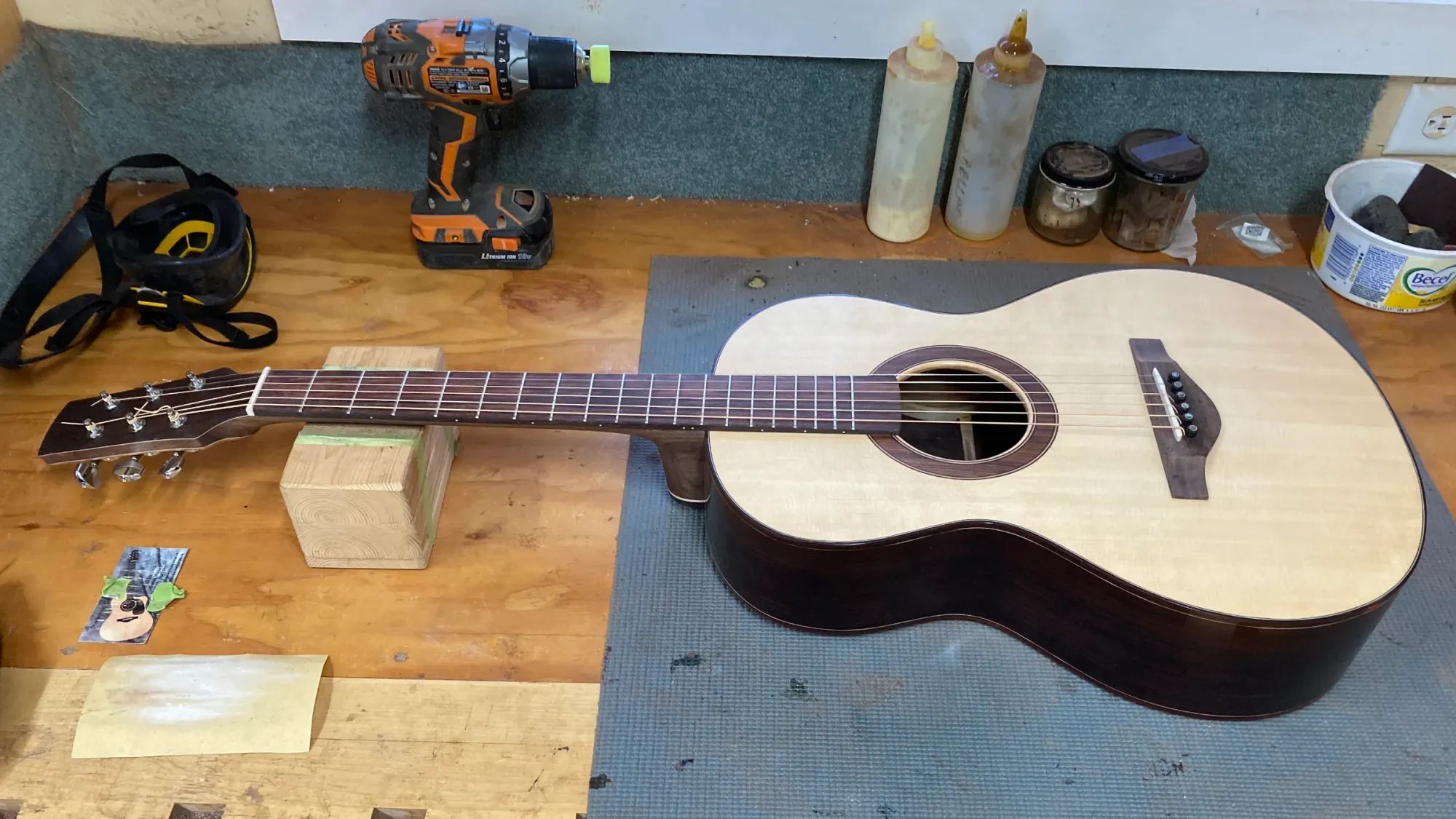
I've been thinking about taking an acoustic guitar building course on and off for about thirty years now. The blocker has been time – most serious courses are at least five weeks long and are effectively full time jobs with overtime. Tuition is also typically $5000+ CAD, which is very reasonable when you consider the course duration and the instructor's investment in the school, but is nevertheless a significant chunk of change. I was able to take the time because I stopped working full time in software development towards the end of last year, for reasons. The tuition could be covered by savings. With that sorted out, I enrolled in the Spring 2026 session at Blackwood Guitar Company in Mallorytown, Ontario.
My goal in writing this is not to give a detailed account of my time at Blackwood ("on day 1, we chose our woods and I almost started a fire in the drum sander" – true story) but to give you an idea of what you might expect from the course.
Blackwood is owned and operated by Ted Brown, a luthier who studied with Sergei DeJonge and Michel Pellerin. Ted also studied cabinetmaking with James Krenov at College of the Redwoods and founded Rosewood Studio. In my experience, Ted is direct and fair, the sort of no-bullshit teacher you should want if you're serious about learning something. He isn't going to do your work for you but he will help you when you need it.
You have your choice of several guitar designs and woods, which you'll choose on the first day. A basic back and sides set is included with the course, or you can upgrade to fancier woods at an additional cost. I chose a twelve fret parlor body style with Indian rosewood back and sides and a lutz spruce top. (I didn't upgrade because I'm cheap and the basic woods were of high quality.) All other materials and tools are provided. Each bench is equipped with a set of basic hand tools. There is also a shared set of hand tools, a machine shop, and more clamps than you've probably ever seen in one place. (And yet, somehow, we still could have used more clamps.)
The course moves very fast. It has to, because getting several students from zero to a completed guitar in five weeks is a tall order. I'm used to working alone and at my own pace in a private workshop, so it took me a few days to get used to working in a shared space and on someone else's schedule. I fell behind early in the course, and while I was never more than a half day behind the rest of the class, it took me about three weeks before I really felt like I had caught up. Be prepared to work hard and at a high level of focus every day, and expect to work overtime on evenings and Saturday mornings.
Ted demonstrates processes at a pace that is intended to keep the class moving forward. That means that you may get a demo hours or days before you'll be ready to carry out the process. The provided notes serve as a good reminder of the order of operations for each process but are often short on details. You need to take your own notes, and take photos and videos of all the demos and setups so you can refer to them later.
Things will go wrong. Wood will be wood. It will not always behave the way you expect. You will make mistakes. You're building a guitar, but you're also going to get some repair experience along the way. Your first guitar was never going to be perfect, so treat problems as learning opportunities and try to recover as gracefully as you can.
There's no guarantee that you'll actually finish your guitar. I gather that most people do, more or less, but it depends on you putting in the work. Everyone in my class finished, and we even had some time to dial in our setups, but we also had the benefit of a smaller than usual class size. My guitar could still use some more finish work on the back and sides, but that's no problem. Ted teaches French polishing in the course, which makes it easy to touch up the finish in the future. For now, I'm enjoying my guitar and not worried about the flaws.
If you're thinking about taking an acoustic guitar building course, I recommend Blackwood. It isn't easy, but if you put in the work you'll be rewarded with a great guitar and a solid grasp of the craft.
My finished guitar.
Thank You for Reading
If you found this post helpful or interesting, please show your support by subscribing or contributing to the tip jar. It will help fund my work and writing.