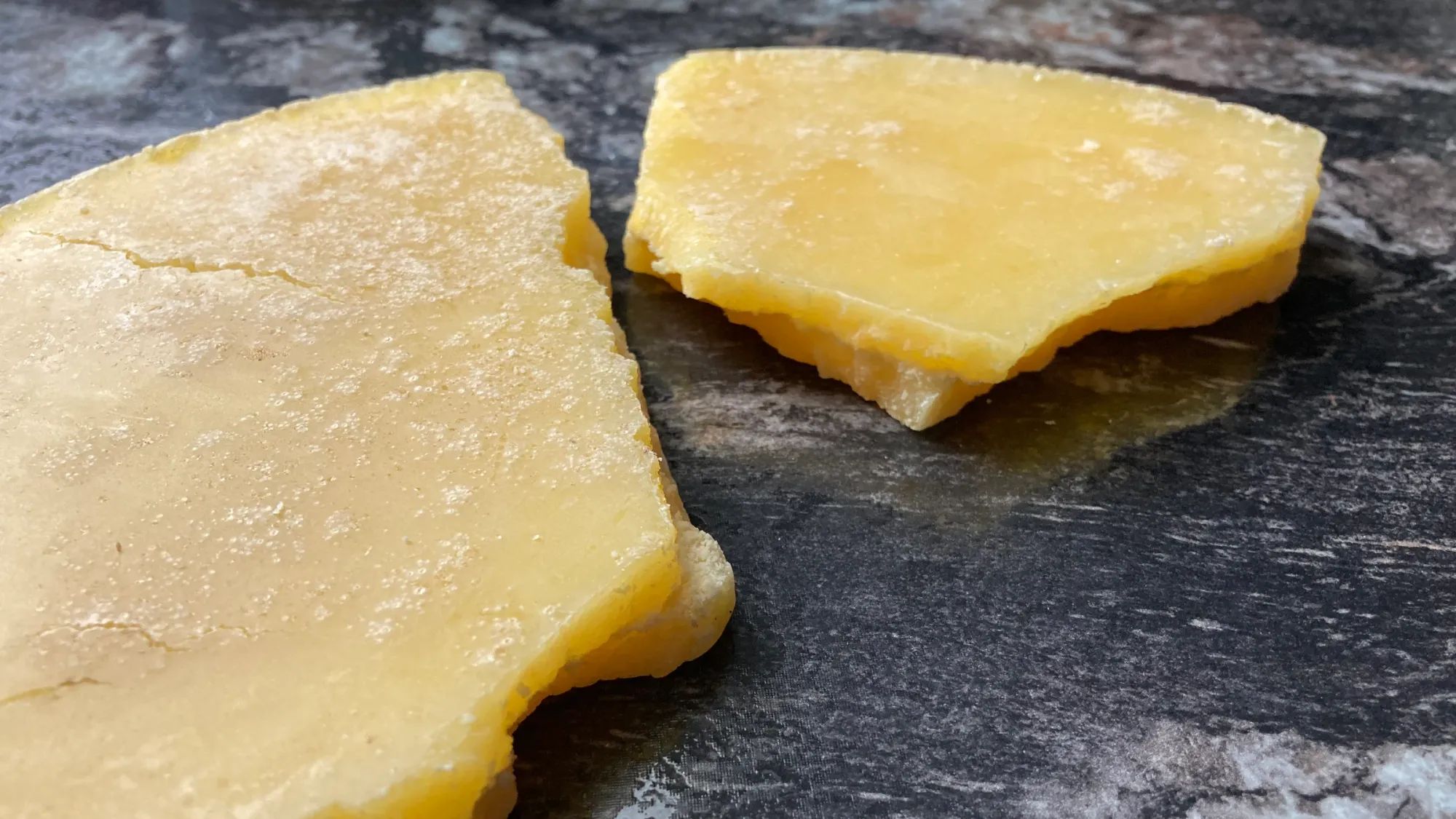

Beeswax paste has a variety of uses. As a wood finish, it's simple to apply, easily reapplied when necessary, and food safe. It's great for lubricating screw threads before driving them into pilot holes – especially the tiny screws for guitar tuners and string trees. It's also a good rust inhibitor for hand tools.
Beeswax paste is also very easy to make. You'll need beeswax, which you may be able to find at a farmers market or natural foods store, and mineral oil. You can buy mineral oil from any pharmacy but it's often a much better value if purchased from a farm supply store. The catch is that you'll have to buy a lot more. I bought a 3.78l jug from a farm supplier for about $35 CAD when my local pharmacy was selling 250ml for $13, but that jug is probably a lifetime supply. Good thing it doesn't spoil.
You can vary the ratio of wax to oil to obtain different consistencies. 1 gram of beeswax to 5ml of mineral oil is a good starting point. 24g of wax and 120ml (1/2 cup) of oil will make enough to last most people for a while.
Combine the wax and oil in a glass or metal container and place it in a water bath. Heat it slowly to a low simmer and stir it until the wax melts. Mix thoroughly until the wax is fully blended into the oil. Remove the water bath from the heat and let the mixture cool to room temperature. It will be liquid at first but will thicken as it cools. Store the wax in the container that you made it in.
WARNING: Mineral oil is flammable. If your cooking surface uses an open flame, e.g. a gas stove, please use an induction burner or hot plate instead. Never leave it unattended or let it come in contact with hot surfaces. The melting point of the wax (approximately 65°C) is far lower than the oil's flashpoint, so the risk will be minimal if you bring the mixture up to temperature slowly and don't let it get hotter than necessary to melt the wax.
To use the paste wax as a wood finish, pick up some wax on a cotton rag and apply it evenly to the surface, rubbing in the direction of the wood grain. Leave it to sit for a few minutes (or more – it won't dry out) and buff it out with a clean rag. Keep in mind that the wax won't harden and isn't the ideal finish for objects that will be subject to a lot of handling. (Also, it might be a bad idea to use it as a finish for a candle holder. See the warning above.)
Thank you for reading!
If you found this post helpful, please consider supporting me by subscribing or sending a tip. It will help fund my work and writing.
- Click here to subscribe
- Click here to send a tip