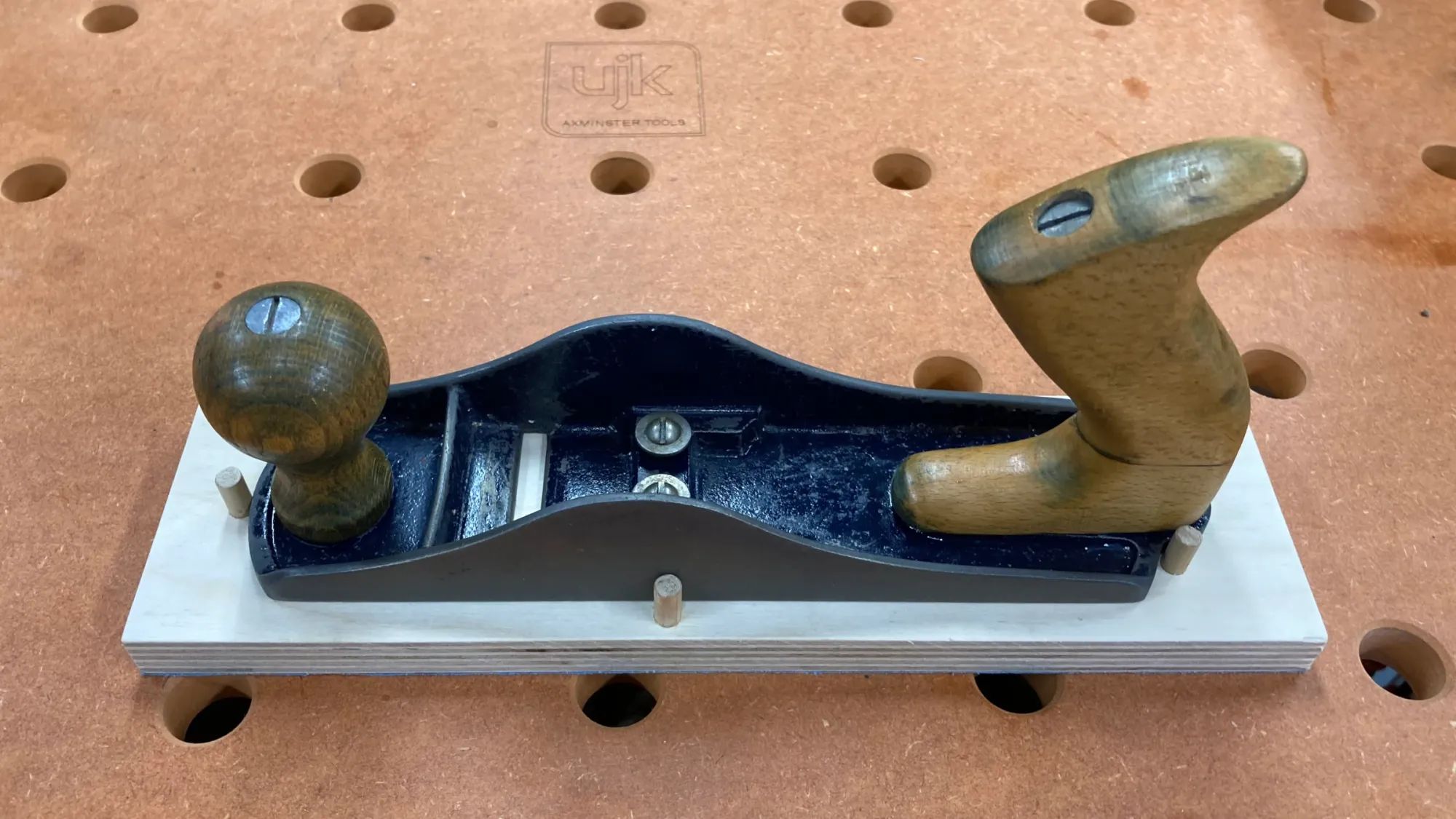
I sanded my first two electric guitar bodies with a block that consisted of a piece of 5/8” birch plywood glued to a half-thickness of 2×4 offcut. The plywood provided a reliably flat substrate for the sandpaper and the 2x4 gave me something to grip. This was a simple solution and it worked well. The problem was that it wasn’t very comfortable to use. I had to take frequent breaks to keep my hand from getting tired. There was also something about the technique of using it that seemed to encourage bad posture, making matters worse.
I thought that the tote and handle from a hand plane would be a good interface for a sanding block. A vendor at my local flea market had a derelict Stanley Handyman #3 plane that I was able to get for $12.50 CAD. Like many junk shop hand planes, it was very rusty and had a broken tote. A night in a tray of EvapoRust followed by some light scrubbing took care of the rust. The break on the tote was clean enough to glue up without worrying too much about the strength of the joint. I also sanded out the handle and tote, and gave them a few fresh coats of shellac. The goal was to make them comfortable, not beautiful.
The new sanding block would be another strip of 5/8" birch plywood, cut to 12x3" to accommodate 1/3 of a 9x12" sheet of sandpaper in portrait orientation. This is a convenient size for the plane bed – if you design for a 1/3 sheet in landscape orientation, you'll need a 9x4" block. That's a bit shorter than the bed of a #3 plane. It might not matter in practice, but I was concerned that it would be easy to dent a workpiece with the overhanging bed if I wasn't careful. (You could also design for a smaller plane bed, but a #3 is what I had available, and is also the smallest plane you're likely to be able to get on the cheap.)
I could have mounted the handle and tote directly to the block, but the plane bed provides perfect mounting points already. Taking advantage of that would eliminate some extra work. The question was how to mount the plane bed to the block. I didn’t want to drill the bed for screws. The Handyman line may not have been Stanley’s best effort but drilling would still ruin a tool that could otherwise be restored and put to use. There was also the risk that the cast iron bed could crack while drilling.